 Purdue University - Extension - Forestry and Natural Resources
Got Nature? Blog
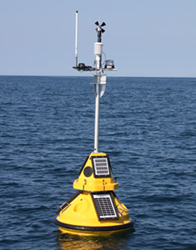
Illinois-Indiana Sea Grant Newsroom: May 2022, Illinois-Indiana Sea Grant (IISG) launched its third buoy in southern Lake Michigan—this one based in the busy waters off Navy Pier. This new buoy with its flow of in-the-moment data is helping the National Weather Service (NWS) Chicago develop more accurate forecasts and warnings, especially related to nearshore wave heights and wind speeds.
This third buoy, known affectionately as Chuoy, joins IISG buoys in the nearshore waters of Michigan City, Indiana and Wilmette, Illinois. Together, these three, along with two University of Illinois buoys closer to the Wisconsin border, paint a comprehensive picture of coastal lake conditions in the two states. In addition to meteorologists, the data is used by scientists, boaters, anglers and beach goers.
“Information from these buoys allows recreational water users to make better informed decisions when it comes to safety,” said Ben Szczygiel, IISG buoy specialist. “The data allows people to plan for current conditions and avoid the water when there are increased safety concerns.”
For full article and videos please visit New to Navy Pier waters, Chuoy the Buoy proved a valuable forecasting tool-IISG
About IISG: These are trying times for the environment. Climate change and other concerns such as population growth, aquatic invasive species, contaminated waters, and loss of natural habitat, the southern Lake Michigan region faces many challenges. Illinois-Indiana Sea Grant (IISG), with its unique mandate to bring the latest science to those who can best use the information, serves a critical role in empowering people to solve problems in sustainable ways. The program is funded through National Oceanic and Atmospheric Administration (NOAA), the University of Illinois and Purdue University, but IISG also works in partnerships with key organizations, institutions, and agencies in the region to reach more audiences and multiply opportunities for success. IISG brings together scientists, educators, policy makers, community decision makers, outreach specialists, business leaders, and the general public to work towards a healthy environment and economy.
Resources
Center For Great Lakes Literacy (CGLL), Website
Ask An Expert: Hot and Cold, Video, Purdue Extension – Forestry and Natural Resources YouTube channel
Informing the Development of the Great Lakes Region Decision Support System, The Education Store, Purdue Extension’s resource center
Urban Best Management & Low Impact Development Practices, The Education Store
Improving Water Quality Around Your Farm, The Education Store
New website: Eat Midwest Fish, Got Nature? Blog, Purdue Extension – Forestry and Natural Resources (FNR)
Scientists bring the Great Lakes to students learning from home, Got Nature? Blog
Adaptations for Aquatic Amphibians Activity 2: Water Quality Sneak Peak, Purdue Nature of Teaching
Illinois-Indiana Sea Grant (IISG)
This is the eighth in a series of consumer guides that describe fish and shellfish farmed in the Midwest region of the United States. The fact sheet also includes culinary characteristics, cooking tips and a recipe for Easy Baked Salmon.
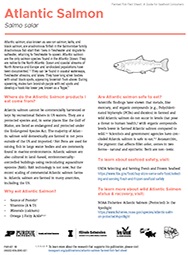
Atlantic salmon, also known as sea-run salmon, kelts, and black salmon, are anadromous finfish in the Salmonidae family. Anadromous fish start their lives in freshwater and migrate to saltwater, returning to freshwater to spawn. Atlantic salmon are the only salmon species found in the Atlantic Ocean. They are native to the North Atlantic Ocean and coastal streams of North America and Europe and landlocked populations have been documented.1,2 They can be found in coastal waterways, freshwater streams, and lakes. They have long silver bodies with small black spots, appearing brownish from above. During spawning, males turn bronzish-purple with red spots and develop a hook-like lower jaw, known as a “kype.”
To receive the free download for the Atlantic Salmon Farmed Fish Fact Sheet please visit The Education Store.
Resources:
Walleye Farmed Fish Fact Sheet, The Education Store, Purdue Extension’s resource center
Pacific White Shrimp Farmed Fact Sheet, The Education Store
Yellow Perch Farmed Fish Fact Sheet, The Education Store
Tilapia Farmed Fish Fact Sheet, The Education Store
Rainbow Trout Farmed Fish Fact Sheet, The Education Store
American Paddlefish, The Education Store
A Guide to Small-Scale Fish Processing Using Local Kitchen Facilities, The Education Store
Aquaculture Family Coloring Book Development, The Education Store
Eat Midwest Fish, Illinois-Indiana Sea Grant online resource hub
Aquatics & Fisheries Videos, Purdue Extension-Forestry and Natural Resources YouTube Channel Playlist
Channel Catfish, The Education Store
Amy Shambach, Aquaculture Marketing Outreach Associate
Purdue Department of Forestry and Natural Resources/Illinois Indiana Sea Grant Program
MyDNR, Indiana’s Outdoor Newsletter: With around 200 different species of fish in Indiana waters, it’s not uncommon that Hoosier anglers might hook a species they’ve never seen before.
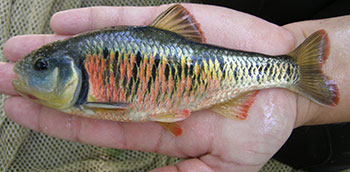
For more information and how to identify fish please visit Fishing Species & Identification.
Send a picture with the location information and date of your catch to fishid@dnr.IN.gov, and a biologist will respond to you with an identification. Not only do you receive an identification, DNR biologists benefit by gaining new information on the distribution of some of our less common species.
Resources:
FNR Extension Aquaculture and Aquatic Resources
FNR Extension Publications
Indiana Pond Fish, Species Identification Card Set, Purdue Extension – Forestry and Natural Resources (FNR)
Walleye Farmed Fish Fact Sheet, The Education Store, Purdue Extension’s resource center
Pacific White Shrimp Farmed Fact Sheet, The Education Store
Yellow Perch Farmed Fish Fact Sheet, The Education Store
Tilapia Farmed Fish Fact Sheet, The Education Store
Rainbow Trout Farmed Fish Fact Sheet, The Education Store
American Paddlefish, The Education Store
A Guide to Small-Scale Fish Processing Using Local Kitchen Facilities, The Education Store
Aquaculture Family Coloring Book Development, The Education Store
Eat Midwest Fish, Illinois-Indiana Sea Grant online resource hub
Aquatics & Fisheries Videos, Purdue Extension-Forestry and Natural Resources YouTube Channel Playlist
Indiana Department of Natural Resources, Department of Fish & Wildlife
Kara Salazar has been promoted to Assistant Program Leader for Purdue Extension Community Development. She has served in this role part-time but will now be fully dedicated to this program area. Kara will maintain her 25% appointment with Illinois-Indiana Sea Grant (IISG) and serve on the Agriculture Natural Resources (ANR) Extension Advisory Committee. She will still be located in the Forestry Building (FORS 308) and affiliated with the Department of Forestry and Natural Resources (FNR).
Working with multidisciplinary teams, Kara oversees the development and delivery of programs to support environmental planning, community development, and sustainable development strategies in communities across Indiana and the Great Lakes states. Kara provides leadership to the Purdue Extension Community Development Program and serves as a liaison between Illinois-Indiana Sea Grant and Purdue Extension.
Kara has a B.S. in public affairs and environmental science and a M.P.A. in natural resources management and nonprofit management from the Indiana University School of Public and Environmental Affairs. She also received a M.S. Ed . degree from the IU School of Education at Indiana University-Purdue University Indianapolis (IUPUI) with concentrations in community building and science education. Additionally, she is a Ph.D. candidate in Natural Resources Social Science at Purdue University. Kara is a member of the American Institute of Certified Planners (AICP), a Climate Change Professional (CC-P), and a Professional Community and Economic Developer (PCED) with credentials from LEED AP Neighborhood Development, the National Green Infrastructure Certification Program (NGICP), and the National Charrette institute.
Congratulations to Kara in her new position as she continues to move Purdue Extension and IISG forward with her expertise and team building.
Check out Kara’s lead role in the following programs and learn about the vast resources available:
Purdue Extension Community Development – strengthens the capacity of local leaders, residents, businesses, and organizations to build resilient, inclusive and sustainable communities through research-based resources and processes. Examples of a few of the programs and resources available include: Leadership and Civic Engagement, Community and Organizational Planning, Economic and Business Development.
Illinois-Indiana Sea Grant (IISG) – utilizes research, outreach, and education to bring the latest science to Great Lakes communities and their residents. By connecting decision-makers with science, we help strengthen and preserve ecosystems and communities in southern Lake Michigan and beyond.
Agriculture & Natural Resources (ANR), Purdue Extension – ANR Educators serve as research based, unbiased information source for county and state constituents on a variety of topics including: crops, ag business, livestock, natural resource, horticulture, small farms, urban ag, pesticide use, and land conservation.
Purdue Extension – a leader in providing relevant, high-impact educational programs that transform he lives and livelihoods of individuals and communities in Indiana and the world. Purdue Extension – Forestry & Natural Resources (FNR) is a branch of the Cooperative Extension Service/Purdue Extension. FNR Extension provides resources for aquaculture, fish management, urban and forestry management, natural re source planning, wildlife, and sustainable biomaterials. We encourage you to browse, download free publications, utilize our Ask an Expert, subscribe to Got Nature? newsletter and view upcoming workshops.
Sustainable Communities Extension Program (SCEP) – provides multidisciplinary teams focusing in the following areas: Placemaking and Enhancing the Value of Public Spaces; Land use Planning Education; Green Infra structure; Community Development; American Citizen Planner; Facilitation and Strategic Planning; Conservation Through Community Leadership; and Rainscaping Education.
More Resources including Kara’s publications and videos:
Implementation Examples of Smart Growth Strategies in Indiana, The Education Store, Purdue Extension’s resource center
Conservation Through Community Leadership, The Education Store
Climate Change and Sustainable Development, The Education Store
Climate Change: Are you preparing for it?, The Education Store
Enhancing the Value of Public Spaces, The Education Store
Enhancing the Value of Public Spaces: Creating Healthy Communities, The Education Store
One Water Approach to Water Resources Management, The Education Store
Rainscaping Education Program, Purdue Extension
Conservation Through Community Leadership, Sustainable Communities Extension Program (SCEP)
Community Planning Playlist, Purdue Extension-Forestry & Natural Resources (FNR) YouTube Channel
Rainscaping and Rain Gardens, Purdue Extension YouTube Channel
Conservation through Community Leadership, Purdue Extension You Tube Channel
Enhancing the Value of Public Spaces Program, Purdue Extension YouTube Channel
Indiana Creek Watershed Project – Keys to Success, Partnerships and People, Purdue Extension You Tube Channel
Subscribe to Purdue Extension – Forestry and Natural Resources YouTube Channel
Diana Evans, Extension and Web Communication Specialist
Purdue University Department of Forestry and Natural Resources
The Help the Hellbender team, led by Dr. Rod Williams, professor of wildlife science, has been honored by the Hoosier Outdoor Writers group with its 2022 Bayou Bill Conservation Award.
The annual conservation award is given in memory of the legendary Crothersville, Indiana, outdoor writer Bayou Bill Scifres, who was a founding member of HOW in 1969, and had his outdoors column published in The Indianapolis Star newspaper for 50 years.
“The Hoosier Outdoor Writers group was introduced to Dr. Rod Williams in 2019 when he came to our annual conference and talked to us about his work with hellbenders and the Help the Hellbenders program,” Tom Berg, Executive Director of HOW, explained. “Our members were very interested in learning more about hellbender conservation and restoration, and also about his involvement with captive breeding and propagation efforts across the state. It was interesting to us to hear that Purdue University, the Indiana Department of Natural Resources and other groups were working together on management plans to re-introduce and re-populate hellbenders throughout much of their historical range. This is exactly the type of conservation story that our members like to hear and relate to their audiences. It also aligns very well with our strong belief in the conservation of Indiana’s natural resources, so choosing Dr. Williams and the “Help the Hellbenders” program for this award was an easy task.”
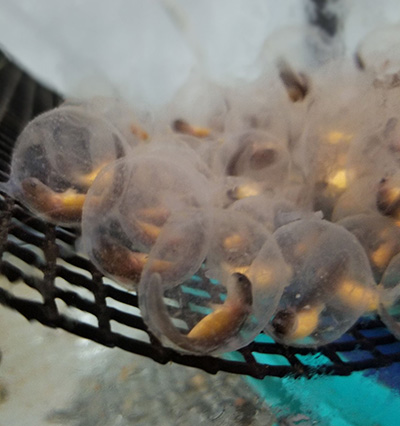
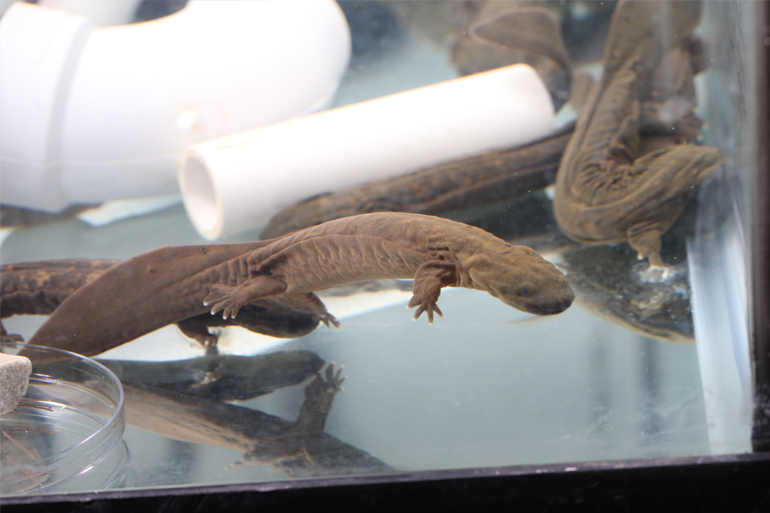 For much of the last 16 years, Williams and his team have been researching eastern hellbenders, spearheading regional conservation efforts and advancing hellbender captive propagation, or the rearing of this ancient animal in captivity and their eventual return to the wild.
After five years of breeding efforts, Williams’ partners at the Mesker Park Zoo in Evansville, Indiana, successfully bred eastern hellbenders naturally in captivity in October 2020, signifying the culmination of a long and collaborative effort to breed the species and restore this endangered species to its native environment.
Williams’ hellbender lab is actively collaborating with the Indiana Department of Natural Resources, Indiana Division of Fish and Wildlife and The Nature Conservancy as well as several other partners across 13 states on a number of conservation projects and educational opportunities for teachers and children, farmers and more.
For full article with additional photos view: Help the Hellbender Program Receives Hoosier Outdoor Writers Conservation Award.
Resources
Help the Hellbender website
Help the Hellbender Facebook page
Ask the Expert: Learn All About Hellbenders and Take a Tour, Subscribe Purdue Extension – Forestry & Natural Resources (FNR) YouTube Channel
Ask the Expert video: Help the Hellbender – Dr. Stephen Spear of The Wilds, Purdue Extension – FNR YouTube Channel
Ask the Expert video: Live with Mesker Park Zoo and Botanical Gardens – Hellbenders, Purdue Extension – FNR YouTube Channel
A Moment in the Wild video: Hellbender Hide, Purdue Extension – FNR YouTube Channel
A Moment in the Wild video: Release Moment of Hellbenders,
How Anglers and Paddlers Can Help the Hellbender video, Purdue Extension – FNR YouTube Channel
Eastern Hellbender ID Video, Purdue Extension – FNR YouTube Channel
Hellbenders Rock!, The Education Store, Purdue Extension’s resource center
Help the Hellbender, North America’s Giant Salamander, The Education Store
How Our Zoos Help Hellbenders, The Education Store
The Nature of Teaching: Adaptations for Aquatic Amphibians, The Education Store
Healthy Water, Happy Home – Lesson Plan, The Education Store
FNR Assists in First Natural Breeding of Eastern Hellbender in Captivity, Purdue FNR News & Stories
Wendy Mayer, FNR Communications Coordinator
Purdue University Department of Forestry and Natural Resources
Channel catfish, commonly known as catfish, are freshwater finfish in the Ictaluridae family. Their native range extends from southern Canada and the Central US to Mexico. They are popular to catch and eat and have been introduced throughout the US and the world for food and recreation. This fact sheet publication shares how to identify the catfish, where they can be found, where you can find catfish products and if they are safe to eat. You will also enjoy the recipe found on this fact sheet.
The Channel Catfish publication is the seventh in a series of consumer guides that describe fish and shellfish farmed in the Midwest region of the United States. (See FNR-608-W, Walleye Farmed Fish Fact Sheet, FNR-618-W, Yellow Perch Farmed Fish Fact Sheet, FNR-621-W, Tilapia Farmed Fish Fact Sheet, FNR-622-W, Rainbow Trout Farmed Fish Fact Sheet, FNR-623-W, Pacific White Shrimp Farmer Fish Fact Sheet and FNR-625-W, American Paddlefish Farmed Fish Fact Sheet). The fact sheet also includes culinary characteristics, cooking tips and a recipe for Classic Fried Catfish.
This publication is a collaborative project of Illinois-Indiana Sea Grant, the North Central Regional Aquaculture Center, University of Illinois Extension, and Purdue University’s Department of Forestry and Natural Resources.
About the Author
Amy Shambach is Illinois-Indiana Sea Grant’s (IISG) aquaculture marketing outreach associate who works with the aquaculture industry in the USDA’s North Central Regional Aquaculture Center. Her work focuses on the demand side of domestic farm raised seafood products. She provides outreach and extension services to producers, potential producers, and consumers. Along with Dr. Kwamena Quagrainie, producers, aquaculture associations, and consumers, she works to determine the needs of stakeholders.
To receive the free download for the Channel Catfish please visit The Education Store.
Resources:
Walleye Farmed Fish Fact Sheet, The Education Store, Purdue Extension’s resource center
Pacific White Shrimp Farmed Fact Sheet, The Education Store
Yellow Perch Farmed Fish Fact Sheet, The Education Store
Tilapia Farmed Fish Fact Sheet, The Education Store
Rainbow Trout Farmed Fish Fact Sheet, The Education Store
American Paddlefish, The Education Store
A Guide to Small-Scale Fish Processing Using Local Kitchen Facilities, The Education Store
Aquaculture Family Coloring Book Development, The Education Store
Eat Midwest Fish, Illinois-Indiana Sea Grant online resource hub
Aquatics & Fisheries Videos, Purdue Extension-Forestry and Natural Resources YouTube Channel Playlist
Amy Shambach, Aquaculture Marketing Outreach Associate
Purdue Department of Forestry and Natural Resources/Illinois Indiana Sea Grant Program
Wild Bulletin, IN DNR Fish and Wildlife: In September, DNR biologists found two species of salamander, the long-tailed salamander, and the southern two-lined salamander, in Knox County, marking the first time since the 1800s that either has been documented along the lower Wabash River.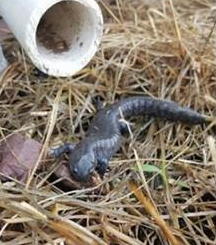
While both species are more widespread in other parts of southern Indiana, the small, rocky streams they inhabit are less common along the lower Wabash. Following this discovery, additional surveys conducted in parts of Knox, Posey, and Sullivan counties revealed more populations of southern two-lined salamanders; however, Knox County contains the only known location of a long-tailed salamander population in the region.
Salamanders and other amphibian surveys conducted by DNR biologists are supported by the Nongame Wildlife Fund. Contributions to this fund support a variety of rare and endangered wildlife.
Please visit Nongame and Endangered Wildlife to determine animals that are listed by the Indiana DNR as endangered or special concerns.
Resources:
Help the Hellbender, Purdue College of Agriculture
Question: Which salamander is this?, Got Nature? Blog, Purdue Extension – Forestry and Natural Resources
Is it a Hellbender or a Mudpuppy?, Got Nature? Blog
Amphibians: Frogs, Toads, and Salamanders, Purdue Nature of Teaching
A Moment in the Wild, Playlist, Purdue Extension – Forestry and Natural Resources
Help the Hellbender, Playlist & Website
The Nature of Teaching: Adaptations for Aquatic Amphibians, The Education Store, Purdue Extension resource center
Hellbenders Rock!, The Education Store
Help the Hellbender, North America’s Giant Salamander, The Education Store
Indiana Department of Natural Resources
The U.S. Department of Agriculture (USDA) announced it is awarding $197 million for 41 locally led conservation projects through the Regional Conservation Partnership Program (RCPP). RCPP is a partner-driven program that leverages partner resources to advance innovative projects that address climate change, enhance water quality, and address other critical challenges on agricultural land.
“Our partners are experts in their fields and understand the challenges in their own backyards,” Agriculture Secretary Tom Vilsack said. “Through RCPP we can tap into that knowledge, in partnership with producers and USDA, to come up with lasting solutions to the challenges that farmers, ranchers, and landowners face. We’re looking forward to seeing the results of public-private partnership at its best, made possible through these RCPP investments.”
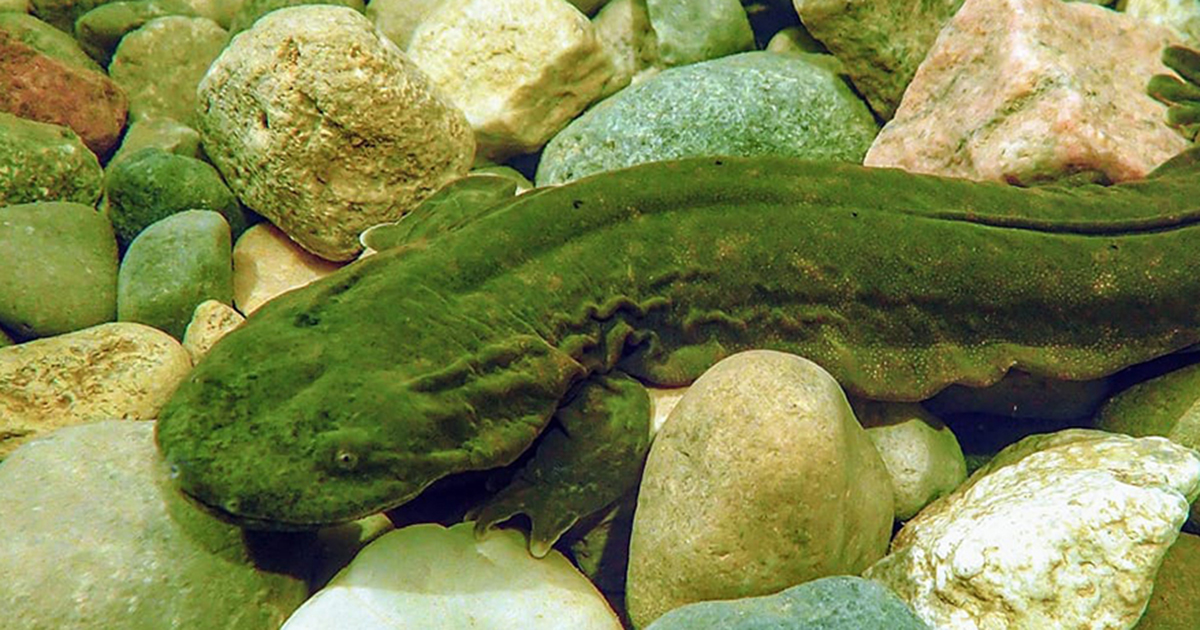
The “Farmers Helping Hellbenders” project, led by Dr. Rod Williams and Purdue Extension wildlife specialist/Help the Hellbender project coordinator Nick Burgmeier, is among the projects set to receive funding through the RCCP Classic fund, which uses NRCS contracts and easements with producers, landowners and communities in collaboration with project partners.
Fourteen contributing partners will assist in the project:
- Mesker Park Zoo and Botanic Gardens
- Fort Wayne Children’s Zoo
- Indianapolis Zoo
- Indiana Department of Environmental Management
- Crawford County Soil and Water Conservation District
- Floyd County Soil and Water Conservation District
- Harrison County Soil and Water Conservation District
- Washington County Soil and Water Conservation District
- Crawford County Cattleman’s Association
- Harrison County Cattleman’s Association
- Washington County Cattleman’s Association
- Cryptobranchid Interest Group
- The Nature Conservancy
- Wallace Center at Winrock International
With help from nearly $2.7 million in RCCP funding, the project aims to improve hellbender habitat in a four-county region in south central Indiana, the only remaining habitat for hellbenders in the state, by expanding the use of agricultural conservation practices that lead to decreased sedimentation in local rivers systems.
Sedimentation is a major cause of hellbender decline and reduced sedimentation will increase available habitat for hellbenders, mussels, and aquatic macroinvertebrates. This project also will address soil and nutrient loss, which are concerns for agricultural producers, as the targeted conservation practices and systems have been shown to have long-term benefits for agricultural systems and operations.
 “Through this initiative, focused on Crawford, Floyd, Harrison, and Washington counties, we expect to improve water quality and aquatic wildlife habitat,” Burgmeier said. “Simultaneously, we hope to improve soil retention and nutrient availability to crops by helping farmers implement practices such as cover crops, riparian buffers, grassed waterways, etc. Additional benefits will include increases in riparian and pollinator habitat and increased protection for karst habitat through the selected targeting of sinkholes.”
As part of each project, partners offer value-added contributions to amplify the impact of RCPP funding in an amount equal to or greater than the NRCS investment. Private landowners can apply to participate in an RCPP project in their region through awarded partners or at their local USDA service center.
“RCPP puts local partners in the driver’s seat to accomplish environmental goals that are most meaningful to their community. Joining together public and private resources also harnesses innovation that neither sector could implement alone,” Indiana NRCS State Conservationist Jerry Raynor said. “We have seen record enrollment of privately owned lands in NRCS’ conservation programs and RCPP will be instrumental in building on those numbers and demonstrating that government and private entities can work together for greater impacts on Indiana’s communities.”
For much of the last 16 years, Williams and his team have been researching eastern hellbenders, spearheading regional conservation efforts and advancing hellbender captive propagation, or the rearing of this ancient animal in captivity and their eventual return to the wild.
Additional Resources
Improving Water Quality by Protecting Sinkholes on Your Property video
Improving Water Quality Around Your Farm video
Adaptations for Aquatic Amphibians
Hellbenders Rock! Nature of Teaching Lesson Plan
Nature of Teaching – Hellbenders Rock Sneak Peek video
Nature of Teaching – Hellbenders Rock webinar video
Learn about hellbenders and take a tour of Purdue’s hellbender rearing facility video
Learn about the hellbender work at Mesker Park Zoo video
Learn about hellbender work at The Wilds video
Dr. Rod Williams’ 2017 TEDx Talk Help the Hellbenders video
A Moment in the Wild – Hellbender Hides video
A Moment in the Wild – Hellbender Release video
Wendy Mayer, FNR Communications Coordinator
Purdue University Department of Forestry and Natural Resources
Rod Williams, Assistant Provost for Engagement/Professor of Wildlife Science
Purdue University Department of Forestry and Natural Resources
The A Guide to Small-Scale Fish Processing Using Local Kitchen Facilities brochure is an overview of what a fish producer thinking about small-scale fish processing needs to know. The overview includes training requirements, available facilities and highlights of select farmers who have gone through the process.
This publication is a collaborative project of Illinois-Indiana Sea Grant, the North Central Regional Aquaculture Center, University of Illinois Extension, and Purdue University’s Department of Forestry and Natural Resources.
About the Author
Amy Shambach is Illinois-Indiana Sea Grant’s (IISG) aquaculture marketing outreach associate who works with the aquaculture industry in the USDA’s North Central Regional Aquaculture Center. Her work focuses on the demand side of domestic farm raised seafood products. She provides outreach and extension services to producers, potential producers, and consumers. Along with Dr. Kwamena Quagrainie, producers, aquaculture associations, and consumers, she works to determine the needs of stakeholders.
To receive the free download for the Guide to Small-Scale Fish Processing Using Local Kitchen Facilities please visit The Education Store.
Resources:
Walleye Farmed Fish Fact Sheet, The Education Store, Purdue Extension’s resource center
Pacific White Shrimp Farmed Fact Sheet, The Education Store
Yellow Perch Farmed Fish Fact Sheet, The Education Store
Tilapia Farmed Fish Fact Sheet, The Education Store
Rainbow Trout Farmed Fish Fact Sheet, The Education Store
American Paddlefish, The Education Store
Aquaculture Family Coloring Book Development, The Education Store
Eat Midwest Fish, Illinois-Indiana Sea Grant online resource hub
Amy Shambach, Aquaculture Marketing Outreach Associate
Purdue Department of Forestry and Natural Resources/Illinois Indiana Sea Grant Program
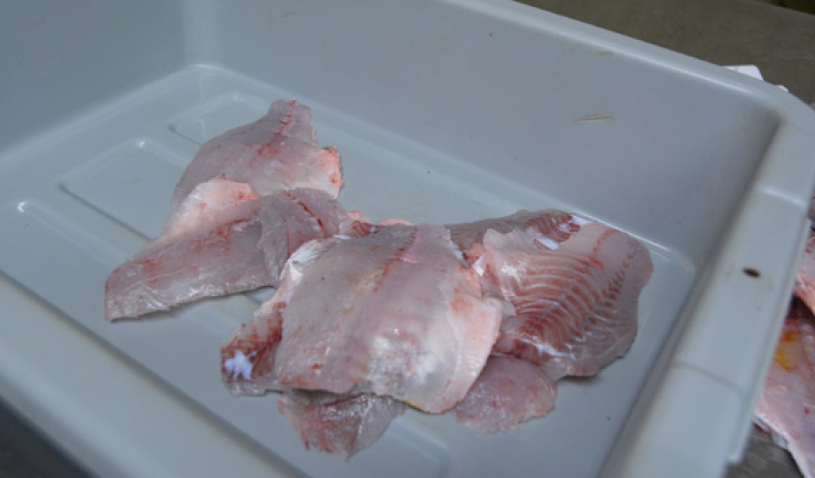 The North Central Regional Aquaculture Center (NCRAC) is supporting a small-scale seafood processing and food safety training for fish farmers in the Midwest. Sponsors for this training session include: Illinois Extension, Purdue Extension and Illinois-Indiana Sea Grant.
Interested fish and aquaponics farmers may sign up for a 2-day HACCP (Hazard Analysis Critical Control Points) training session. The location of farmers will determine how many training sessions will be available and the training session locations.
If you are highly interested and willing to commit to the process, please complete this survey as soon as possible. Seats are limited!
Sign up through this link:
https://purdue.ca1.qualtrics.com/jfe/form/SV_cuaAzf30VfRZixo
For any questions please contact:
Kwamena Quagrainie, Aquaculture Economics/Marketing Specialist
Illinois-Indiana Sea Grant/Purdue Forestry & Natural Resources/Purdue Agricultural Economics/Purdue Extension – FNR
Amy Shambach, Aquaculture Marketing Outreach Associate
Illinois-Indiana Sea Grant/Purdue Extension- FNR
Taylor Bradford, Aquaculture Extension Assistant
Illinois-Indiana Sea Grant/Purdue Forestry & Natural Resources/Purdue Agricultural Economics
Resources:
Fish: Healthy Protein Handout, The Education Store, Purdue Extension resource center
Walleye Farmed Fish Fact Sheet: A Guide for Seafood Consumers, The Education Store
Fish Cleaning with Purdue Extension County Extension Director, Got Nature? Blog, Purdue Extension – Forestry and Natural Resources (FNR)
What is Aquaponics?, Got Nature? blog, Purdue Extension – FNR
Eat Midwest Fish, Website
Sustainable Aquaculture: What does it mean to you?, The Education Store
Best Practices Guide for Charter Fishing and COVID-19, The Education Store
Pond Management: Managing Fish Populations, The Education Store
Aquatics & Fisheries, YouTube Playlist, Purdue Extension – FNR
Purdue Aquaponics: Cut Water Usage, YouTube Channel, Purdue Extension – FNR
Largemouth Bass Fingerling Production, YouTube Channel, Purdue Extension – FNR
North Central Regional Aquaculture Center (NCRAC)

Recent Posts
- Discover the Great Lakes, The 2025 Helm Magazine is Available
Posted: November 17, 2025 in Aquaculture/Fish, Aquatic/Aquaculture Resources, Wildlife - Illinois-Indiana Sea Grant Newsletter Shares New Resources
Posted: November 13, 2025 in Aquaculture/Fish, Aquatic/Aquaculture Resources, Wildlife - Publication – Fish Muscle Hydrolysate
Posted: September 15, 2025 in Aquaculture/Fish, Aquatic/Aquaculture Resources - Publication – Direct Marketing Guidebook for Small/Medium-Scale Aquaculture Businesses
Posted: March 7, 2025 in Aquaculture/Fish, Aquatic/Aquaculture Resources, Publication - Conservationists Unite for Snuffbox Mussels – Wild Bulletin
Posted: February 20, 2025 in Aquaculture/Fish, Aquatic/Aquaculture Resources, Wildlife - Publication – Handbook on Processing Fish for Small-Scale Fish Farmers
Posted: October 17, 2024 in Aquaculture/Fish, Aquatic/Aquaculture Resources, How To, Publication, Wildlife - IISG Adds New Water Safety Videos
Posted: May 8, 2024 in Aquaculture/Fish, Aquatic/Aquaculture Resources, Community Development, Great Lakes, Wildlife - Farmers Helping Hellbenders RCPP Program Accepting Applications
Posted: May 1, 2024 in Aquaculture/Fish, Forestry, How To, Wildlife, Woodlands - 2024-25 Fishing Guide now available – Wild Bulletin
Posted: April 4, 2024 in Alert, Aquaculture/Fish, Aquatic/Aquaculture Resources, How To, Ponds, Wildlife - Look Out for Invasive Carp in Your Bait Bucket – Wild Bulletin
Posted: March 31, 2024 in Alert, Aquaculture/Fish, Aquatic/Aquaculture Resources, Invasive Animal Species, Wildlife
Archives
Categories
- Alert
- Aquaculture/Fish
- Aquatic/Aquaculture Resources
- Ask the Expert
- Christmas Trees
- Community Development
- Disease
- Drought
- Forestry
- Forests and Street Trees
- Gardening
- Got Nature for Kids
- Great Lakes
- How To
- Invasive Animal Species
- Invasive Insects
- Invasive Plant Species
- Land Use
- Natural Resource Planning
- Nature of Teaching
- Plants
- Podcasts
- Ponds
- Publication
- Safety
- Spiders
- Timber Marketing
- Uncategorized
- Urban Forestry
- Webinar
- Wildlife
- Wood Products/Manufacturing
- Woodland Management Moment
- Woodlands