November 5, 2019
Purdue joins Quantum Economic Development Consortium
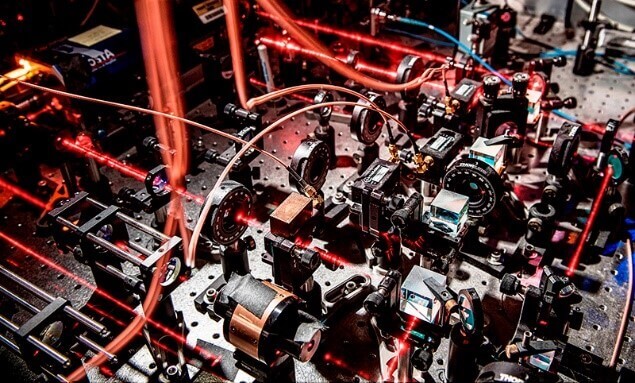 Purdue researchers’ vast expertise (such as using lasers to create and manipulate quantum systems, pictured) will allow them to contribute to the quantum ecosystem development and educate the future quantum workforce. (Purdue University photo/Purdue Quantum Science and Engineering Institute)
Download image
Purdue researchers’ vast expertise (such as using lasers to create and manipulate quantum systems, pictured) will allow them to contribute to the quantum ecosystem development and educate the future quantum workforce. (Purdue University photo/Purdue Quantum Science and Engineering Institute)
Download image
Purdue has signed an official letter of intent to collaborate in the Quantum Economic Development Consortium (QED-C). The QED-C was established as part of the federal strategy for advancing quantum information science as called for by the National Quantum Initiative Act of 2018.
The QED-C grew out of support from the National Institute of Standards and Technology and today includes participation from multiple government agencies, diverse industry, and academia. QED-C participants are working together to identify gaps in technology, standards, and workforce and to address those gaps through collaboration.
Purdue is well-positioned to contribute to the QED-C via the already established Purdue Quantum Science and Engineering Institute (PQSEI) located in Discovery Park, which brings together expertise from over 40 Purdue faculty members and promotes interdisciplinary collaboration in a number of areas that are critically important to the QED-C.
“We are extremely excited to collaborate in the QED-C,” says Yong Chen, the Karl Lark-Horovitz Professor of Physics and Astronomy, professor of electrical and computer engineering, and inaugural director of PQSEI. “The expertise of our faculty will make Purdue and PQSEI valuable contributors in the support and development of a robust quantum ecosystem in the United States.”
Although the letter of intent was just recently fully executed, Purdue has been involved from early in the evolution of the QED-C. Alexandra Boltasseva, professor of electrical and computer engineering and inaugural Discovery Park fellow, has been involved in the QED-C from early on. She was joined at the most recent meeting at the beginning of October by Pramey Upadhyaya, assistant professor of electrical and computer engineering, and David Stewart, managing director of PQSEI. Boltasseva and Upadhyaya are also participants in the workforce technical advisory committee, which identifies education and workforce development needs to support the emerging quantum industry.
“The current quantum workforce is significantly underdeveloped and shorthanded,” Boltasseva says. “As a public university, we have an obligation to train the next generation of quantum scientists and engineers to meet the growing needs, and our participation in the workforce technical advisory committee allows us to brainstorm with other academia and obtain feedback from industry and government on the best ways to accomplish this.”
About Discovery Park
Discovery Park is a place where Purdue researchers move beyond traditional boundaries, collaborating across disciplines and with policymakers and business leaders to create solutions for a better world. Grand challenges of global health, global conflict and security, and those that lie at the nexus of sustainable energy, world food supply, water and the environment are the focus of researchers in Discovery Park. The translation of discovery to impact is integrated into the fabric of Discovery Park through entrepreneurship programs and partnerships.
About Purdue Quantum Science and Engineering Institute
Located in Discovery Park, PQSEI fosters the development of practical and impactful aspects of quantum science, and focuses on discovering and studying new materials, devices and basic physical quantum systems that will be suited for integration into tomorrow’s technology. It encourages interdisciplinary collaboration leading to the design and realization of quantum devices with enhanced functionality and performance close to the fundamental limit, aiming to ultimately bring them to a vast community of users. PQSEI faculty work on a broad range of topics in quantum science and technologies including quantum materials and devices, quantum photonics, atomic molecular and optical physics, quantum chemistry, quantum measurement and control, quantum simulation, and quantum information and computing.