Cybersecurity Awareness Month

Celebrate Cybersecurity Awareness month with Purdue!

Events

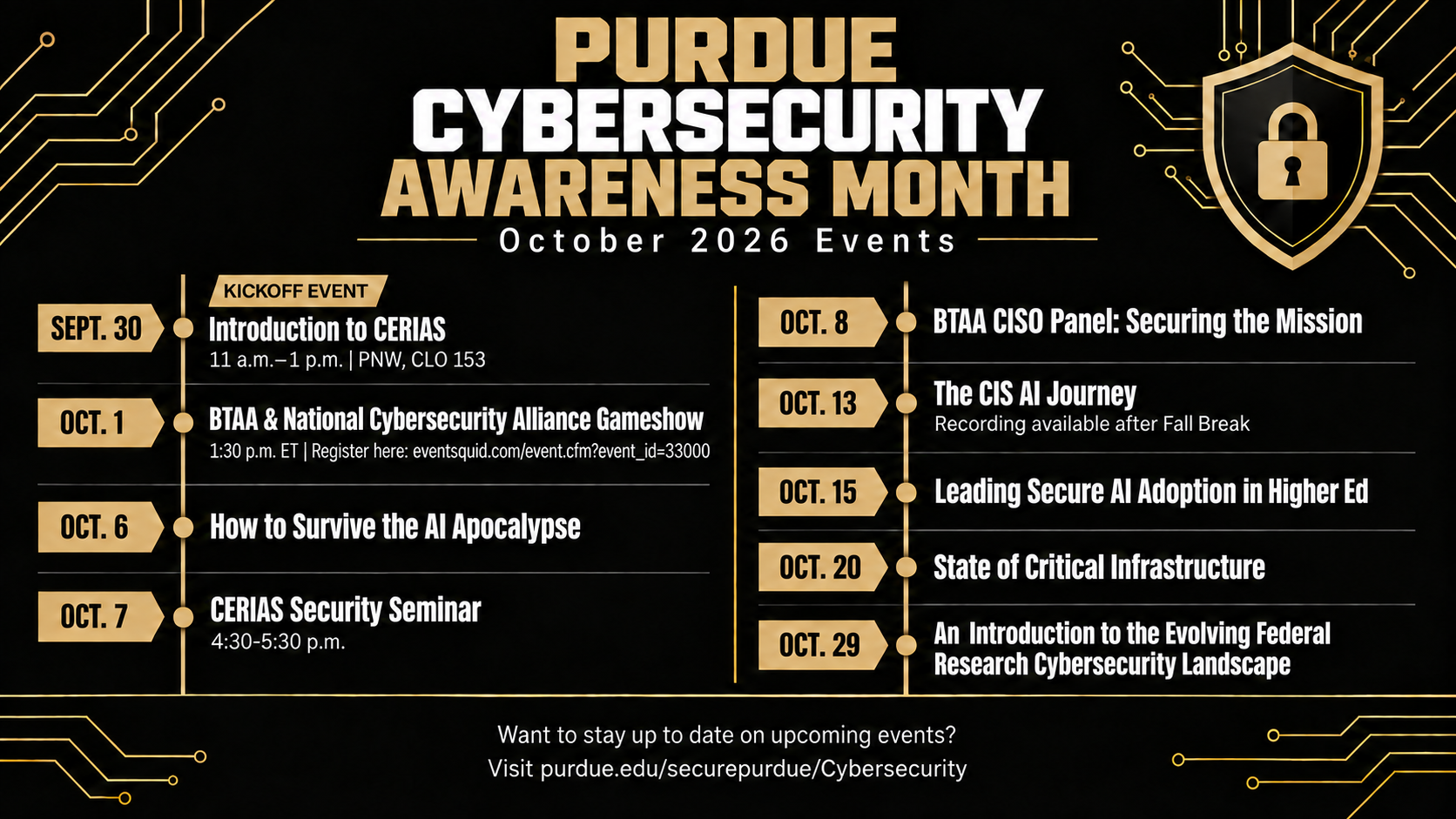
Events are for everyone, including students, faculty, and staff. All times are listed in ET. Learn more about BTAA Events

See overview of events:overview of events

CERIAS Security Seminar

Twenty years ago, the first post on the CERIAS blog took apart the rule that passwords must be changed every month. NIST retired the practice in 2017; some standards still require it. That is how a security myth works: a plausible claim, repeated in enough checklists, becomes infrastructure, and nobody audits infrastructure that seems to be working. The newest myth is that AI makes security professionals optional. This talk separates the three claims that marketing bundles together. AI tools do find flaws in shipped code, and the evidence from Google, DARPA, Mozilla, and Microsoft is real. Autonomous agents do add kinds of risk that no deployed security architecture was designed for. Neither fact implies that fewer people are needed. The vulnerability flood of 2026 is an audit of forty years of deferred engineering, not a crisis AI created, and the bottleneck has moved to the human capacity to verify, coordinate, and fix. The organizations that bet on replacement are already rehiring, often at a premium, the judgment they discarded. Open positions in the field number in the hundreds of thousands. For students, the message is direct: AI is not replacing you; it is generating your workload. The talk closes with what grows, what shrinks, and how to prepare. The capacities that make you a professional are the ones that do not become obsolete with the next model release. WHEN: October 7th, 4:30pm - 5:30pm. WHERE: Science Building (INLD), Room LD 002, Purdue Indianapolis & Virtual

The CIS AI Journey

Most organizations are being asked to adopt AI faster than they can answer basic questions about how to do it safely. At the Center for Internet Security, we chose to build our AI program governance first, before scaling use across the organization. This session walks through that journey candidly, including the questions we got right early, the ones we underestimated, and the places where our first plan needed real adjustment. Brian Calkin, CIS Chief Technology and Innovation Officer, will share how CIS stood up an AI governance board and a technical subcommittee, deployed enterprise AI tooling to staff, and worked through the security and data questions that surfaced along the way. What data can these tools touch? How do we vet vendors? Who reviews an agent before it acts on its own? How do we keep cost and sprawl under control? The talk focuses on what actually worked, what we changed, and what we are still figuring out. For higher education, the stakes are distinctive. Research, administrative, and IT environments each carry different data sensitivities and risk tolerances, and scaling AI across all three without a shared governance foundation invites trouble. Attendees will leave with a practical starting framework they can adapt, a set of questions worth answering before broad rollout, and a clear view of the tradeoffs from an organization living them now. WHEN: October 13th, 12:00 pm - 1:00 pm. WHERE: Virtual. NOTE: Recording will be available after fall break.

The Way We Travel the World Is at Risk

The Way We Travel the World Is at Risk: GPS Origins, Recent Disruptions, and Alternative Paths to Resilient Positioning. Abstract: GPS was formally approved as a U.S. Department of Defense program in December 1973 and developed as a military system for precise three-dimensional positioning, navigation, and timing—driven in large part by requirements for accurate munitions and missile guidance. The first developmental satellite launched in 1978; the system reached full operational capability in 1995. Civilian access was authorized beginning in the 1980s and later expanded widely into aviation, maritime shipping, and consumer devices. Its radio-frequency signals in the L-band enable global positioning through time-of-flight ranging, yet the same open, relatively weak signals that made GPS ubiquitous have become a systemic vulnerability. Recent incidents illustrate the stakes: a man jamming the Denver International Airport in January 2022 disrupted GPS over a roughly 50-nautical-mile radius for about 33 hours, affecting aircraft and other critical infrastructure; GPS jamming contributed to the 2024 Azerbaijan Airlines crash (38 fatalities) after loss of navigational aids near Grozny; AIS anomalies linked to GPS interference preceded the 2025 Front Eagle–Adalynn tanker collision near the Strait of Hormuz; and widespread jamming in Ukraine has driven the rapid adoption of fiber-optic-controlled drones. Mitigation efforts range from stronger LEO signals (Xona Space Systems' Pulsar) to physical tethers that bypass radio entirely, multi-modal feature fusion architectures that incorporate optical flow and geo-registration (such as Northrop Grumman's ANAGDA), and inertial/photonic systems. This talk examines these approaches as partial mitigations of a radio-based paradigm and contrasts them with fundamentally different sensing modalities—such as visual and topological fingerprinting of environmental features developed by Xphera—that reframe the positioning problem itself. Ultimately, this illustrates a broader cybersecurity lesson: every technology has inherent weaknesses, and it is common to develop tunnel vision focused solely on mitigating the risks of the original solution. Sometimes the most effective path forward is to return to identify the problem at a foundational level and apply different technologies to achieve the same outcomes. WHEN: October 21, 4:30 pm - 5:30 pm. WHERE: Virtual

For any cybersecurity awareness related questions or training requests, please email  cyberaware@purdue.edu.

Purdue Global Purdue Fort Wayne Purdue Northwest Purdue West Lafayette