Purdue News
Purdue News

|
|
June 30, 1991 Purdue "Trojan Horse" Inserts Molecules Into CellsWest Lafayette, Ind. — Purdue University researchers have become the first to develop a method to insert large molecules — such as antibodies, enzymes, proteins and genes — into cells without damaging or changing the cell structure. The accomplishment opens doors to a new realm of possibilities in drug delivery, and may someday lead to improved treatments for a number of diseases, including cancer and diabetes. "Basically, what we have constructed is a Trojan horse that we can use to carry virtually any molecule into almost any growing cell," said Philip S. Low (rhymes with how), the professor of chemistry who directed the studies. His findings are reported in the July 1 issue of the Proceedings of the National Academy of Sciences.
The challenge of getting large molecules across the cell membrane has defied scientists for years. Small molecules, such as those used in today's pharmaceuticals, have been specifically designed to enter a cell by passing through the membrane or slipping through one of the cell's regular transport systems. Large molecules, however, cannot be designed to enter cells through these routes. Low's method offers the first delivery system capable of inserting large molecules into the tissues of living plants and animals without damaging the cell membranes or the materials being introduced. Using this approach, medical researchers may be able to draw upon a number of large molecules — such as proteins, antibodies, enzymes, toxins and genes – to treat disease. Possible applications include insulin treatments or vaccines that can be taken orally. The technology may also be used to target medications to cancer cells, increase the efficiency of drugs that are poorly absorbed by the body, or to introduce proteins or enzymes into cells lacking in these substances. However, Low cautions that medical applications of the technology have yet to be tested. The technique makes use of one of the cell's natural pathways to carry molecules across the membrane. Called endocytosis (en-doe-cyToE-sis), this process is used by cells to bring selected materials — such as a few vitamins and hormones — from outside the cell membrane into the cell. The Purdue group found that by attaching large molecules to folic acid — a member of the vitamin B complex and one of only a few vitamins that use the endocytosis pathway to enter cells — the unrelated molecule is also allowed to enter the cell. "Because most cells have an avid appetite for vitamins, they will swallow the vitamins even if another molecule is attached," Low says. The method is similar to the Trojan horse strategy used by the Greeks to gain entrance to Troy. "The vitamin can conceal the unrelated molecules and carry them past the gates of the cell membrane," he says. Using vitamins to transport large molecules offers several advantages. "First, these pathways are present in nearly all cells because all cells require vitamins," Low says. "Also, because most cells require a fair amount of vitamins to conduct their biochemistry, the uptake is fairly high, so this method offers an efficient way to deliver molecules into cells." The research team has also had success using riboflavin and biotin, two more members of the vitamin B family. The molecules are attached to the vitamins by using one of a number of chemical linkers developed by the research group. Though hormones also use the endocytosis pathway to enter cells, Low says these compounds do not provide good vehicles for transporting unrelated molecules into cells. "Because hormones are brought into their target cells specifically for the purpose of destroying them, any molecule attached to the hormone would be destroyed also," Low says. Vitamins, on the other hand, are used for nourishment and are sustained once inside the cell. Low's group has observed that vitamin-linked molecules can survive and flourish for more than six hours after entering a cell — long enough for a protein or antibody to begin the process of modifying the biochemistry of the cell.
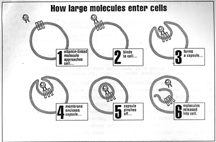
Getting Large Molecules Into Cells— Purdue researchers have developed a way to deliver large molecules — such as proteins and genes — across cell membranes by first attaching them to common everyday vitamins. Disguised by the vitamins, the large molecules are transported through the cell membrane using one of the cell's natural pathways to bring vitamins into the cell. The above illustration shows the steps involved. The technique may someday be used to improve treatment for a number of diseases, including cancer and diabetes. |