
October 4, 2004
Purdue's comparative oncology program to celebrate 25th anniversary
WEST LAFAYETTE, Ind. – Purdue University's School of Veterinary Medicine will sponsor "Purdue Comparative Oncology Program – Celebrating 25 Years of Excellence" on Monday (Oct. 11) with a daylong event for veterinarians from around the state and the Chicago area.
|
Alan Rebar, dean of the School of Veterinary Medicine, will give opening remarks for the program at 9 a.m. in Lynn Hall, Room 1136. Purdue veterinarians specializing in oncology research will give talks throughout the day on topics including skeletal and urologic oncology, the biology of cancer in dogs and humans, comparative oncology, environmental risk factors for cancer, cancer prevention, and novel forms of cancer therapy.
"The presentations will focus on our research success, current program goals and where comparative oncology is going," said Deborah Knapp, Purdue veterinary oncologist and professor of veterinary clinical sciences. "We want to help pet animals, and the information we gather from our research can also help humans."
In the last 25 years, the program has:
• conducted studies that are improving the outlook for pet animals with cancer and have led to human clinical trials.
• assisted in the care of more than 20,000 pet animals with cancer.
• trained 16 oncology residents.
• been involved in the education of more than 1,200 veterinarians.
The three program co-founders, who were Purdue faculty members when the program was started, will be attending the event: Ralph Richardson, dean of the School of Veterinary Medicine at Kansas State University; William Carlton, the Leslie Morton Hutchings Distinguished Professor Emeritus of Pathology at Purdue; and Gordon Coppoc, head of the Department of Basic Medical Sciences at Purdue, assistant dean of the Indiana University School of Medicine, and director of the Lafayette Center for Medical Education at Purdue.
Rebar says the co-founders were far ahead of their time in their vision for the program.
"It is remarkable that 25 years ago, these three Purdue faculty members recognized the value of studying naturally occurring cancer in pet animals as a means of also improving understanding, treatment and prevention of similar cancers in humans," Rebar said. "Though novel at that time, this approach is now widely recognized as an important approach to medical discovery."
Current faculty leaders of the program are veterinary clinical sciences professors Knapp and David Waters and associate veterinary clinical sciences professor Michael Lucroy.
The focus of Purdue's Comparative Oncology Program, which treats about 1,000 cancer patients per year, is to determine and study forms of naturally occurring cancer in pet dogs and cats whose diseases closely mimic the human condition. Much of the work has been focused on bone, urinary tract and prostate cancer.
Another activity of the program is to train future veterinary oncologists and comparative cancer researchers.
Writer: Reni Winter, (765) 496-3133, rwinter@purdue.edu
Sources: Deborah Knapp, (765) 494-1107, knappd@purdue.edu
Michael Lucroy, (765) 494-1141, mlucroy@purdue.edu
David Waters, (765) 494-9271, waters@purdue.edu
Purdue News Service: (765) 494-2096; purduenews@purdue.edu
Note to Journalists: Broadcasters who would like advance video or b-roll for the event should contact Jesica Webb, Purdue News Service marketing director, at (765) 494-2079, jwebb@purdue.edu. Journalists wishing to cover the event should make prior arrangements by contacting Kevin Doerr, Purdue School of Veterinary Medicine, (765) 494-8216, doerrkr@purdue.edu.
Related releases:
Corralling Cancer
Research finds lawn chemicals raise cancer risk in Scottish terriers
PHOTO CAPTION:
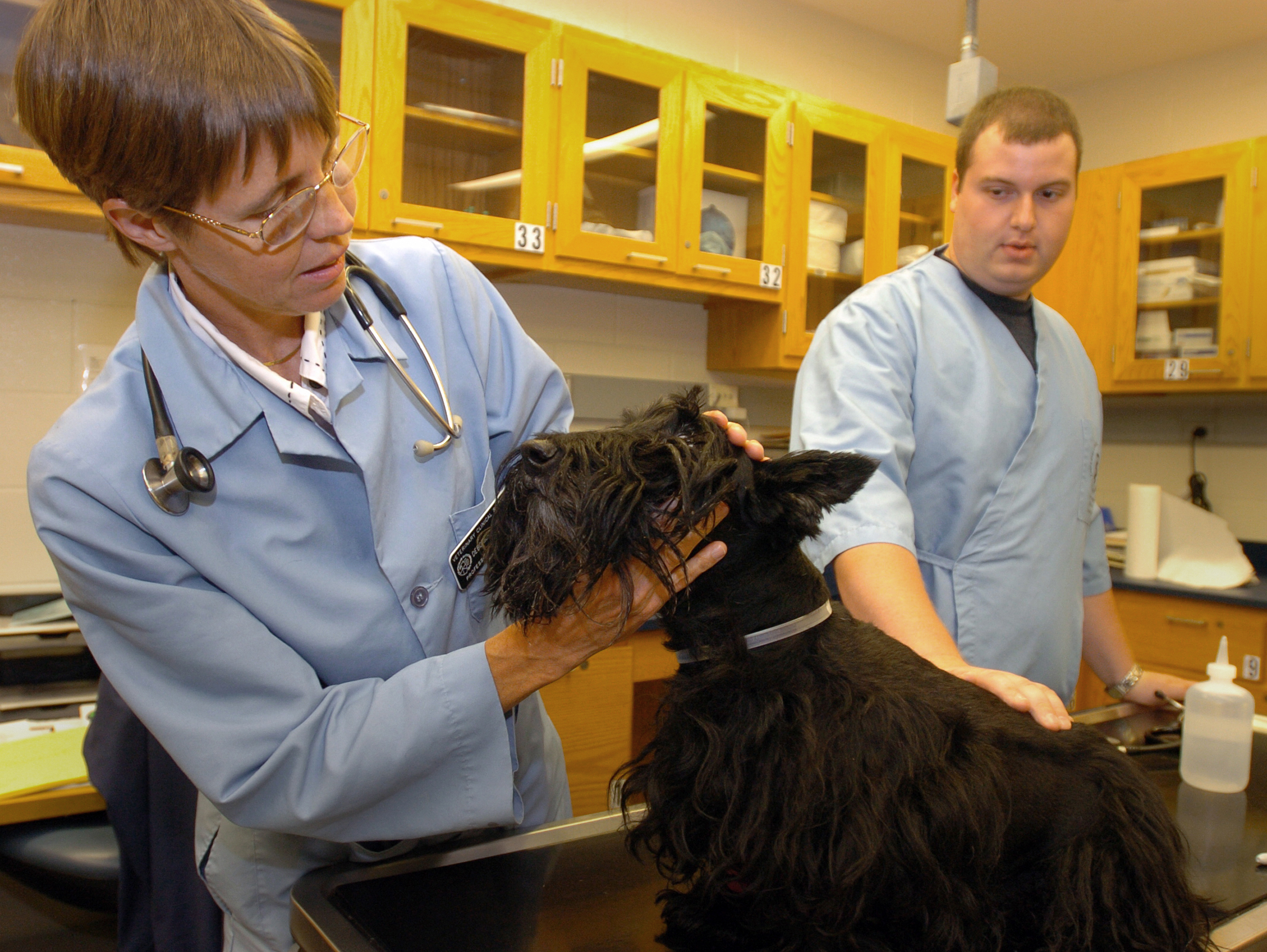
Purdue veterinary oncologist Debbie Knapp examines Bear, a 12-year-old Scottish terrier, in the oncology treatment room at the School of Veterinary Medicine's Small Animal Hospital. Assisting her is Brent Herzberg, a preveterinary student from South Bend, Ind, who is a volunteer with the oncology service. Purdue veterinarians annually treat about 1,000 patients with cancer. (News Service photo/Dave Umberger)
A publication-quality photograph is available at https://www.purdue.edu/uns/images/+2004/knapp-vetoncology.jpg
To the News Service home page