
Healthy as a horse? Appearance can tell a lot
WEST LAFAYETTE, Ind. — Even someone who doesn't know much about horses can learn a lot about equine health just by watching the post parade from the stable to the gates during the May 6 Kentucky Derby, says an equine veterinarian at Purdue University.
|
"Body condition, or a horse's degree of fat cover, is a good indicator of its general health," Sojka says. "Many traits of good health in horses can be recognized at a glance. Others require a closer look."
Some specific indicators of health in horses include:
• attitude — a bright, actively interested horse will be alert, inquisitive and attentive.
• hair coat — a shiny, glossy hair coat shows good nutrition and health.
• hoof growth — hooves should be smooth with no cracks and should form a straight line with the front of the lower leg.
• eyes — appearance should be bright, fully open and clear.
• hydration — a horse's water balance can be determined by pinching a fold of skin on the neck, pulling it out and counting the number of seconds the skin takes to return to its original position.
• manure/urine — normal manure balls are firm and urine is wheat-straw colored.
• mucous membrane color — a horse's gums and lip membranes should be healthy and pink.
• gums — gently pressing against the gums and counting the number of seconds required for the color to return will show a horse's circulation.
• heart rate — a resting, mid-sized adult horse will have a heart rate of 40-45 beats per minute.
• respiratory rate — an adult horse at rest will have 8-16 breaths per minute.
• temperature – a horse's body temperature is 98-101 degrees.
Sojka says these are general health indicators, but horse owners should always contact their veterinarian if they have concerns. She can talk about a wide variety of horse health issues, including equine diseases, first-aid emergency treatment and foal care.
Writer: Maggie Morris, (765) 494-2432, maggiemorris@purdue.edu
Source: Janice Sojka, (765) 494-8548, sojkaje@purdue.edu
Purdue News Service: (765) 494-2096; purduenews@purdue.edu
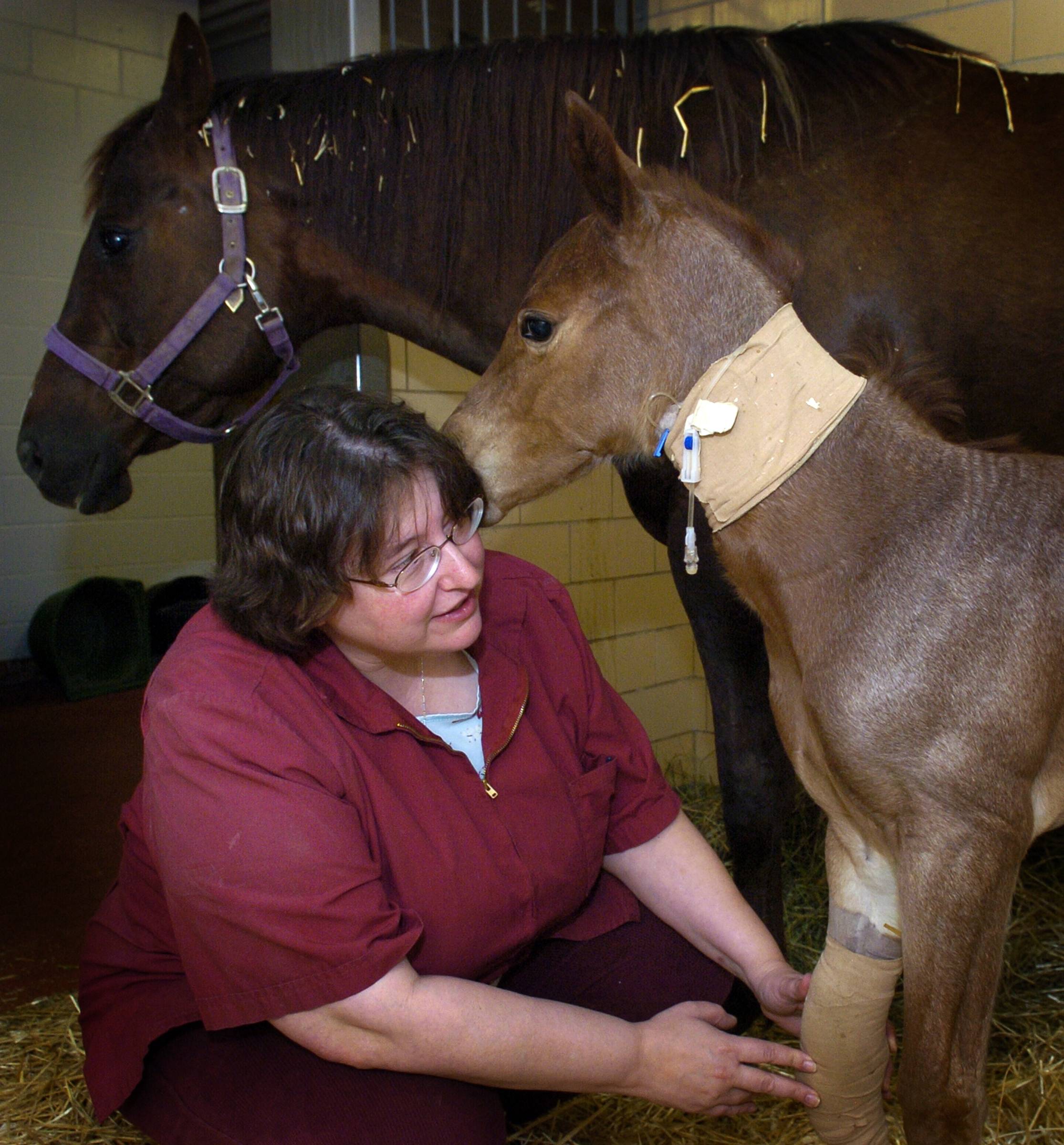
PHOTO CAPTION:
Janice Sojka, equine veterinarian at Purdue University's School of Veterinary Medicine, performs a post-surgery exam on 10-day-old foal while mom watches closely. The foal came to Purdue's Large Animal Hospital with infected joints and is responding well after surgery and antibiotics. (Purdue News Service photo/David Umberger)
A publication-quality photo is available at https://www.purdue.edu/uns/images/+2006/sojka-horses.jpg
To the News Service home page