
| RELATED WEB SITES |
| * Howard Hughes Medical Institute |
| * HHMI Bio for Jue Chen |
| * Purdue Cancer Center |
| * Purdue biological sciences home page |
| RELATED NEWS RELEASES |
| * Purdue researchers obtain a snapshot clarifying how materials enter cells |
| * Purdue biologists clarify how a cellular 'spacecraft' opens its airlock |


May 29, 2008
Purdue scientist appointed Howard Hughes Medical Institute investigator
WEST LAFAYETTE, Ind. -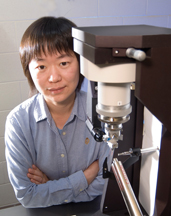 |
Chen is the only current investigator in Indiana and the third person ever to be appointed from an Indiana institution.
The Howard Hughes Medical Institute, or HHMI, will provide salary and research support to the Chen Lab for at least five years as part of the institution's investigator program.
HHMI collaborates with universities, medical centers and research centers throughout the United States to conduct basic biomedical research.
The investigator program employs more than 300 of the nation's most innovative scientists. These scientists are widely recognized for their creativity and productivity: 124 are members of the National Academy of Sciences, and 12 have been honored with the Nobel Prize.
Chen has focused on determining the structure and function of ABC transporter proteins that use energy to transport molecules across the cell membrane. These proteins act as gatekeepers and control what goes into and out of a cell. Insights from Chen's research could be key to treatments for diseases such as cancer and cystic fibrosis.
"It is a great honor to have one of our researchers recognized by the innovative and highly esteemed Howard Hughes Medical Institute," said Jeffrey S. Vitter, the Frederick L. Hovde Dean of the College of Science. "Jue Chen and the Purdue Structural Biology Group are performing research that is needed to find cures for the most devastating diseases."
HHMI changed the way it selects investigators to ensure that candidates are drawn from a broader and deeper pool of scientists and opened up a general competition to the direct application process, according to the institute.
"This was the first time people could apply directly without being nominated by their host institute," said Chen, who also is a member of the Purdue Cancer Center. "Being a Howard Hughes Medical Institute investigator will allow my group to expand our research and follow where the data leads because the institute funds people rather than a specific project."
Researchers with 4 to 10 years of experience as faculty members were eligible to apply. The applications were reviewed by a panel of distinguished biomedical scientists, and 56 investigators were chosen from 1,070 applicants.
“Opening the competition to a direct application process allowed us to identify new investigators who are working in areas that have historically been core strengths of the Institute, such as neuroscience and structural biology,” said Jack E. Dixon, vice president and chief scientific officer at HHMI. “But we have also added research fields that have not been strongly represented in the past. This is truly an expansion for HHMI.”
The institute has a philosophy of "people, not projects" and appoints promising individuals as investigators rather than awarding a grant for a specific research project. The investigator determines a research path and is free to change its direction, according to the institute.
“These 56 scientists will bring new and innovative ways of thinking about biology to the HHMI community,” said Thomas R. Cech, president of HHMI. “They are poised to advance scientific knowledge dramatically in the coming years, and we are committed to providing them with the freedom and flexibility to do so.”
Chen is a member of Purdue's structural biology group, the Purdue Cancer Center and Purdue's Center for Basic and Applied Membrane Sciences.
Purdue's structural biology group studies a diverse group of problems, including cellular signaling pathways, RNA catalysis, bioremediation, molecular evolution, viral entry, viral replication and viral pathogenesis. Researchers use a combination of X-ray crystallography, electron cryomicroscopy, NMR spectroscopy, and advanced computational and modeling tools to study these problems.
The Purdue Cancer Center is one of just seven National Cancer Institute-designated basic research facilities in the United States. It was established in 1976 and attempts to help cancer patients by identifying new molecular targets and designing future agents and drugs for effectively detecting and treating cancer. The center also is affiliated with the Oncological Science Center in Purdue's Discovery Park.
Purdue's Center for Basic and Applied Membrane Sciences was established to utilize the expertise of 45 faculty members. The center fosters collaboration in 12 areas of basic and applied membrane sciences, with the mission to improve basic biochemical and biophysical understanding of membrane sciences and to develop applications that are important in medicine, physiology and engineering.
Writer: Elizabeth Gardner, (765) 494-2081, ekgardner@purdue.edu
Sources: Jue Chen, (765) 496-3113, chenjue@purdue.edu
Jeffrey S. Vitter, (765) 494-1730, sciencedean@purdue.edu
Purdue News Service: (765) 494-2096; purduenews@purdue.edu
To the News Service home page