Comparing Fuel Values: The Virtual Lab
In this virtual investigation, students will explore how much energy is released when various fuels are burned. The amount of energy released per gram of fuel, measured in joules (J), is known as the fuel value. By conducting controlled virtual experiments, students will measure and compare the fuel values of several different substances. The goal is to determine which fuel releases the most energy.
High school teacher, Robyn Embry, discusses how to set up the apparatus for the Comparing Fuel Values investigation along with tips for safety and best practices when performing this investigation in person. Robyn provides possible post-lab discussion prompts that can be used with this lab. She concludes the video with an explanation on how to apply the C.E.R. format (Claim, Evidence, and Reasoning) to guide students in a reflection about the Comparing Fuel Values investigation.
This is a virtual lab or lesson plan, depending on your needs.
This lab, which focuses on determining the fuel value of various fuel types, employs spirit lamps for combustion. The lab guide provides a comprehensive walk through for students, covering the experimental setup and data collection procedures. Additionally, a post-lab discussion video is included to assist students with data analysis. For those who prefer not to use spirit lamps for direct student experimentation, we have provided videos of each fuel burn, including corresponding data collection.
The student page, accessible via the link below, is a complete resource for this lab. It includes all necessary materials, such as a pre-lab discussion video, videos showcasing five different fuel types, post-lab discussion videos, and a student worksheet/lab handout.
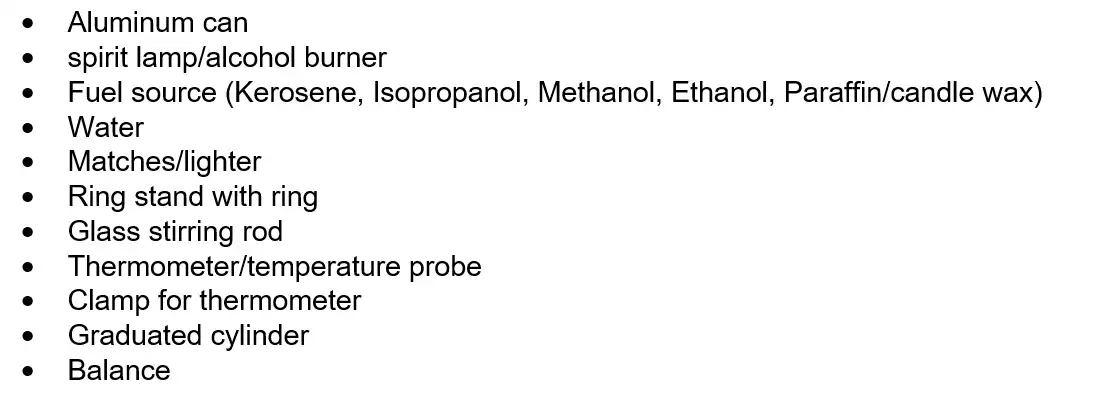
Materials for each group: (if doing in person)
Disclaimer:
Teachers are responsible for ensuring that all safety protocols and procedures are strictly followed during this laboratory activity. The creators of this lab are not liable for any accidents, injuries, or other issues that may arise from its implementation. Do not complete this lab in person if you do not fully understand all of the lab safety procedures required.
C.E.R. Format for Student Reflection:
Using the C.E.R. format (Claim, Evidence, and Reasoning) can help students reflect on their investigation into the comparison of fuel values.
- The claim, or hypothesis statement, should directly relate to the question that students are investigating. For this lab, students are asked to make a hypothesis about which type(s) of fuel will have the highest fuel value.
- Students present a summary of their results, which can be accompanied by a graph, as evidence to either support or refute their original claim. Students should only use data they specifically collected during their lab investigation.
- Students put their reasoning into words by defining the terms they are using and clarifying the concepts demonstrated throughout the investigation. By writing a reasoning statement, students are providing evidence to their teacher that they understand all that the investigation entailed. Potential sources of error can be included in the reasoning statement to help students either justify the claim they’ve made or refute those arguments.
Extension Topics:
Teachers may wish to continue discussions and/or investigations related to the Comparing Fuel Values lab. Following are some ideas related to fuel values.
- Looking at the environmental impacts of fuel sources (including a discussion related to air pollution)
- Extending the investigation of fuel values to include both renewable and non-renewable fuel sources
- The ethics involved with extraction, processing, and transportation of fuel sources (Consider the potential for oil spills that exists in transporting fossil fuels)
- The ethics involved with using food crops (i.e. corn) to produce biofuels such as ethanol
- (Organic chemistry) Compare different types of alcohol-based fuels in terms of their fuel values
- Discuss potential sources of error that may have occurred as part of this lab investigation (Example: Heat is lost to surroundings)
Links for this lab
References
Flinn Scientific. (2016). Soda can calorimeter. Publication No. 10861. Flinn Scientific. https://www.flinnsci.com/api/library/Download/f9560a5fc7ef4a6b8f4598fea30626eb?srsltid=AfmBOoqPqLwA9oHjW7ryr56_3dVvNf5iU-BABz3JzAL4WEl9gSQ4hArg
Wells, E. (2009). Alternative transportation fuels. Lab Manual for Environmental Science. Brooks/Cole, Cengage Learning.
Funding for this lab was graciously provided by Purdue University College of Science.