Subatomic: An Atom Building Game (Adapted for use in the science classroom)
OVERVIEW
This lesson utilizes an adaptation of the board game Subatomic: An Atom Building Game to help students learn about the different parts that make up an atom. During their turn, players can choose to "Buy" deck building cards, "Build" the atom on their Player Mat, "Take" Energy Tokens by playing cards from their hand face down, and "Claim" Element cards from the main game board. Players score points from the Element cards they claim and from the Goal Marker cubes that are played on the main game board. The adaptation for this game was created for use during one 45-minute class period.
OBJECTIVE
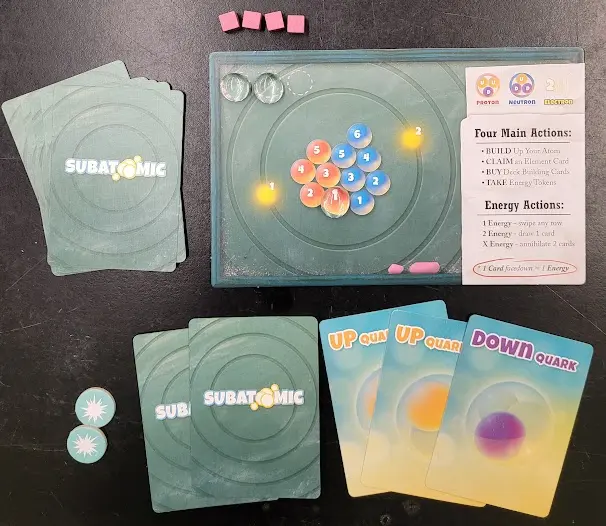
Players start the game with their own small deck of cards that includes 4 Up Quark cards, 4 Down Quark cards, and 3 Photon/Gamma Ray cards. Players use these cards to create subatomic particles (protons, neutrons, and electrons), or buy more powerful cards for their deck. Players ultimately build Elements on their own Player Mat which allows them to "Claim" Element cards from the Main Game Board and score points.
LEARNING GOALS
- Students will learn about the different particles that make up an atom.
- Students will understand that the mass of an atom is determined by the number of protons and neutrons in that atom's nucleus.
MATERIALS
(1) Subatomic: An Atom Building Game board game
- 1 board game set will accommodate up to 5 participants (2-4 Players, 1 Game Master)
Interactive Periodic Table (The Royal Society of Chemistry)
Quick Start Guide (for Students)(Word docx)
Main Game Board Play Mat (Word docx)
Subatomic: An Atom Building Game (Student Worksheet) Word docx.
Teachers: Request an Answer KEY
PDF copies for printing labels used to organize game cards and pieces
- Player Starting Materials - 2" x 4" (in.) Shipping Labels (Avery Template 16791) Word docx.
- Game Master Starting Materials - 2" x 4" (in.) Shipping Labels (Avery Template 16791) Word docx.
- Game Setup Labels - 1" x 2 5/8" (in.) Easy Peel Address Labels (Avery Template 5260) Word docx
NOTE: If you need pdf versions for printing purposes, please go to our other page: Superheroes of Science - Subatomic
GAME SETUP
The designated Game Master will help with the following tasks. If a group of 4 or fewer students are playing and do not designate a game master, they should all help with the following tasks.
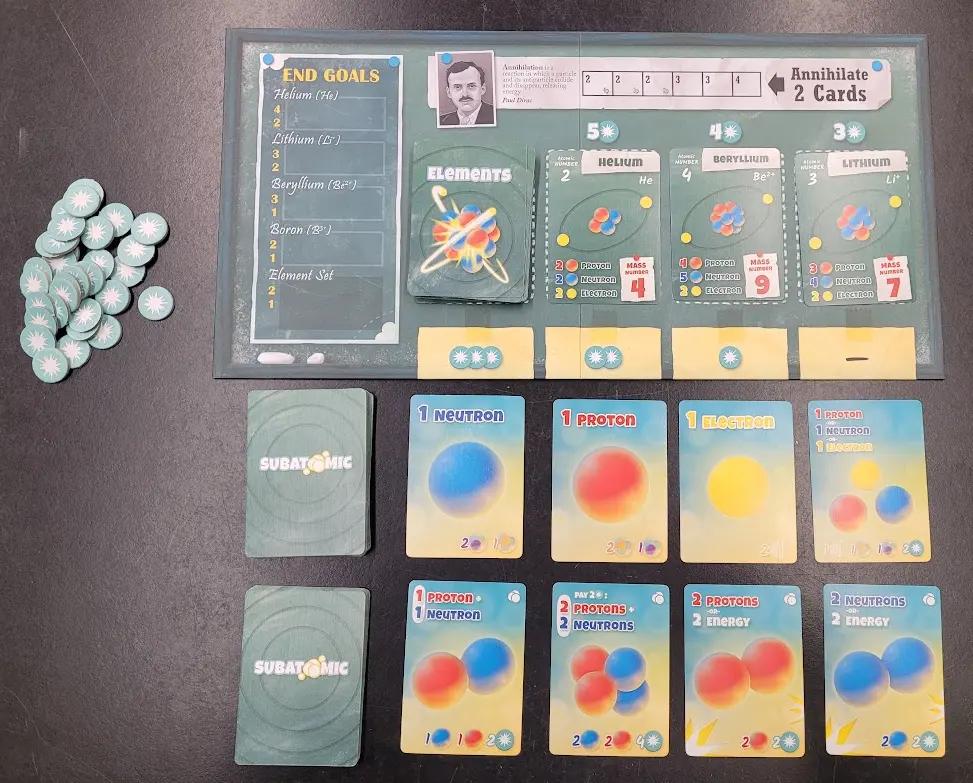
- Place the main game board near the top of the play area.
- Place all the Energy Tokens near the main game board.
- Place the main game board mat (laminated) directly BELOW the main game board.
- Shuffle the Element card deck and place the deck face-down on the Draw Pile spot,
(LEFT side of the main game board). - Draw 3 Element cards and place one face-up in each of the three Element spots,
(CENTER of the main game board). - Shuffle the Single Subatomic card deck and place the deck face-down,
directly BELOW the “End Goals” section of the main game board. - Draw 4 cards from the Single Subatomic card deck and place one face-up in each
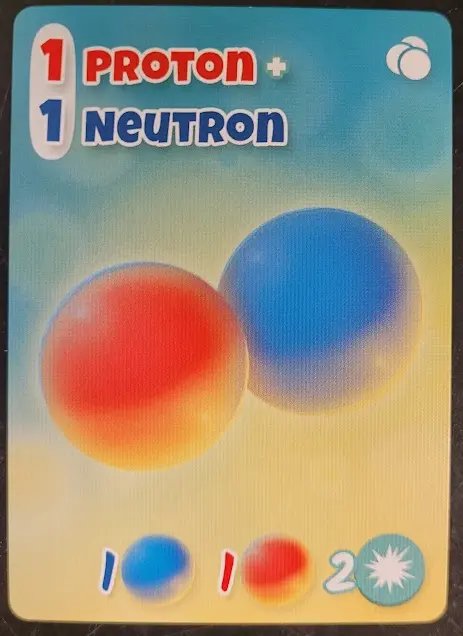
of the spots on the laminated mat, directly BELOW the main game board. - Shuffle the Larger Subatomic card deck (these cards have a special icon in top right corner - See Photo 4). Place this deck face-down directly BELOW the Single Subatomic card deck.
- Draw 4 cards from the Larger Subatomic card deck and place one face-up in each
of the spots on the laminated mat, directly BELOW the Single Subatomic face-up cards. - **During Setup Only** If any three of the face-up Element, Single Subatomic, or Larger Subatomic cards are exactly the same, replace the leftmost copy of the card with a new card from its respective deck. Shuffle any removed cards back into its deck.
Players will complete the following tasks.
- Decide who will be Players and who will be the Game Master (GM).
- The Game Master receives their Starting Materials.
- The Game Master sets up the main game board.
- Each Player receives their Starting Materials.
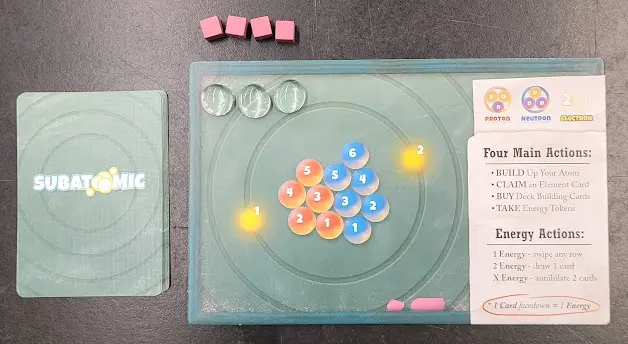
- Players shuffle their Starter card deck and place it face-down to the LEFT of their Player Mat. This is the start of their personal Draw Pile which will be used to replenish their hand throughout the game.
- Players should leave space below their Player Mat for a “Cards in Play” area, and space to the right of their Player Mat for a Discard Pile.
- Each player should place their 3 glass Particle Markers on the three holding places in the UPPER LEFT corner of their Player Mat. The 4 Goal Marker cubes should be placed ABOVE the Player Mat.
- Each player draws 5 cards from their Draw Pile to form their hand.
- The FIRST PLAYER is the player seated to the RIGHT of the GM. Players continue to the RIGHT of Player 1.
- If there is not a GM, the FIRST PLAYER is the player with the first name that is alphabetically last. In the case of a tie, go with “Rock-Paper-Scissors” - Best 2 of 3 games.
QUICK START
Watch this video to see the setup and learn about actions each player can take during the game.
GAMEPLAY
During a Player's turn, any of the following actions can be completed. Players can complete as many actions during their turn as they have resources for. (This section can be found on Page 2 of the Game Master guide under the Materials section.)
- Players can "Buy" deck building cards. These are cards in the 2 rows BELOW main game board.
- Players must pay the cost of each card listed at the bottom AND pay the Energy Token cost listed on the main game board ABOVE the card they want to buy.
- After “BUYING” a deck building card, the new card goes directly into the Player’s Discard Pile. Cards used to “BUY” the new card go into the Player’s Discard Pile. Energy Tokens used to “BUY” the new card go back to the main game board.
- Players can “Take” Energy Tokens by playing cards from their hand face-down.
- Any card played face-down during a player’s turn is worth 1 Energy Token.
- Players can "Build" the atom on their Mat
- The goal is to build an atom that matches one of the face-up Element cards so that a player can claim that Element card and score points.
- Play cards from your hand face-up in your “Cards in Play” area to add corresponding subatomic particle(s) to your atom.
- Use either starter cards, or purchased Subatomic cards, to add protons, neutrons, and electrons on the Mat.
- Players can “Pay” 2 Energy Tokens to Draw 1 card from their Draw Pile.
- Players can “Pay” 1 Energy Token to reset the cards in any one row of the main game board.
- If at any time a player has 3 Identical cards in their current hand, they may show them to the GM (or to the other players if there is not a GM), place one of the 3 Identical cards into their Discard Pile, and replace it with a card from their Draw Pile.
- Players DO NOT have to play all 5 cards. Players can save cards in their hand for their next turn.
- Players can "Claim" Element cards from the main game board.
- To do this, a player must have accumulated on their Player Mat AT LEAST the number of protons, neutrons, and electrons shown on the Element card they wish to claim.
- The player will pay the energy cost listed directly ABOVE the Element card they are claiming.
- Subtract the protons, neutrons, and electrons from their Player Mat based on the Element card they claim. If all of one type of particle is used, place the Particle Marker back on the upper left corner.
- Place the claimed Element card face down above their Player Mat.
- Place 2 of their Goal Marker cubes on the End Goals section of the main game board. The 2 Goal Markers can be placed together, or separate, on any spaces EXCEPT FOR the space that matches the Element card that was just claimed.
ENDGAME
Endgame begins when one player has claimed 2 Element cards from the main game board and placed all 4 of their Goal Marker cubes in the "End Goals" section of the main game board.
- Each player (excluding the player who triggered the endgame situation) takes one final turn.
- Element cards, Single Subatomic cards, and Larger Subatomic cards should all be replenished as needed after each player's turn.
FINAL SCORING
Each player adds up the following to calculate their TOTAL score:
- Element cards (Point values are indicated by the Mass Number on the bottom right corner of each Element card.)
- End Goals (Players receive additional points based on how many Goal Marker cubes they placed in the "End Goals" section of the main game board.)
APPLICATION to NEXT GENERATION SCIENCE STANDARDS
Middle School:
- MS-PS1-1: Develop models to describe the atomic composition of simple molecules.
- This includes understanding atoms as the building blocks of matter, as well as the arrangement of protons, neutrons, and electrons.
High School:
- HS-PS-1: Use the periodic table as a model to predict the relative properties of elements based on the patterns of electrons in the outermost energy level.
- Students must understand atomic structure and how electrons are arranged.
- HS-PS1-8: Understand the composition of the nucleus of the atom to be able to develop models that illustrate nuclear changes in composition during the processes of fission, fusion, and radioactive decay.
- Students should understand the basic structure of the atomic nucleus.
DISCIPLINARY CORE IDEAS
PS1.A: Structure and Properties of Matter
- (Middle School) Each atom has a nucleus made of protons and neutrons, surrounded by electrons.
- (High School) The structure and properties of atoms (including protons, neutrons, and electrons) determine how elements interact.
CROSSCUTTING CONCEPTS & SCIENCE and ENGINEERING PRACTICES:
- Scale, Proportion, and Quantity: Atoms and subatomic particles exist on an extremely small scale.
- Structure and Function: The arrangement of protons, neutrons, and electrons determines an atom's properties and interactions.
- Developing and Using Models: Construct models of atoms to represent subatomic particles.
REFERENCE
Coveyou, J. J. (2019). Subatomic: An Atom Building Game [Board game]. Genius Games.